
Energetic Patterns as a Model of Practice Within Therapeutic Yoga
Exploring the Elements, Doshas, and Vayus Through the Pancha Kosha Framework

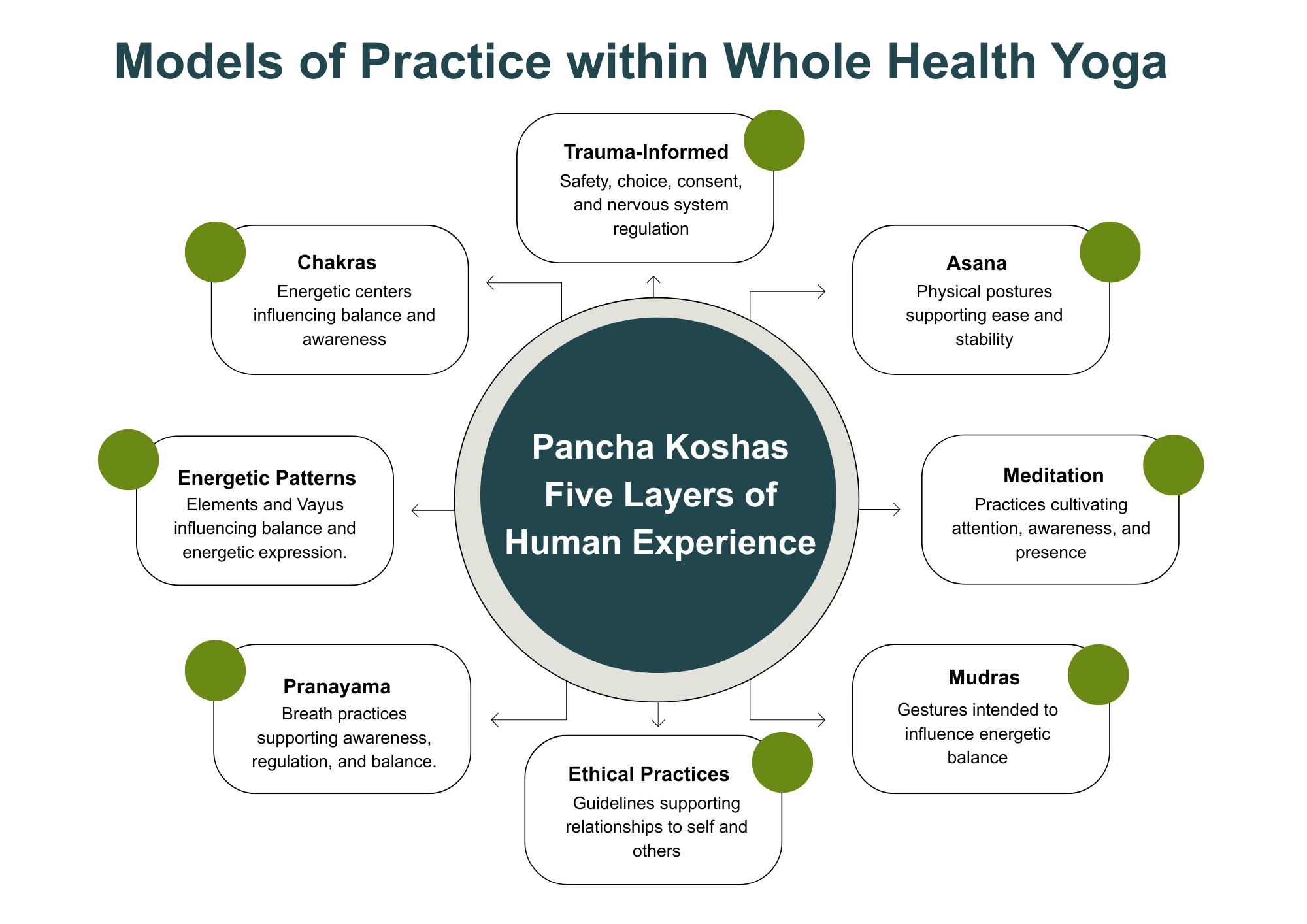
Within Whole Health Yoga’s approach to yoga therapy, the models of practice are not approached as isolated techniques, but rather as interconnected approaches that support whole-person well-being. The Pancha Koshas provide the framework for understanding the many layers of human experience. Previous blogs have explored trauma-informed yoga principles, ethical practices, meditation,pranayama, asana, and the chakra system. Each offers a different perspective for understanding health while contributing to an individualized therapeutic approach.
In this blog, I explore how the energetic patterns of yoga—including the five elements, the Ayurvedic doshas, and the five vayus—serve as another model of practice within the broader Pancha Kosha framework. Together, these perspectives help explain how energy may be expressed throughout the many layers of human experience and guide the development of individualized therapeutic yoga practices.
Understanding the Five Elements
The five elements—earth, water, fire, air, and space—are foundational principles within both yoga philosophy and Ayurveda. Rather than representing physical substances alone, they describe qualities that are continuously expressed throughout nature and within each of us.
Earth reflects stability, structure, nourishment, and steadiness.
Water represents adaptability, fluidity, connection, and rhythm.
Fire relates to transformation, metabolism, motivation, and purposeful action.
Air expresses movement, communication, creativity, and change.
Space creates openness, perspective, possibility, and the capacity for all other qualities to exist.
Within therapeutic yoga, none of these qualities are considered inherently good or bad. Health is not created by eliminating an element, but by cultivating balance among them. Throughout life, different circumstances may call for different qualities to become more or less prominent.
The Elements Within the Pancha Kosha Framework
Within Whole Health Yoga, I use the Pancha Koshas as the framework for understanding a client's current experience. The qualities of the five elements provide another lens through which those experiences may be explored.
Rather than asking whether someone is predominantly one dosha or another, I begin by observing which elemental qualities appear most present within each kosha. Is there excessive movement within the mental-emotional layer? Is there depletion within the energetic layer? Is the physical body lacking stability? Are life circumstances creating excessive intensity or transformation?
Viewing a client through the qualities of the elements allows me to better understand not only what may be contributing to imbalance, but also which therapeutic practices may be most supportive.
After identifying which kosha, or combination of koshas, appears most relevant to a client's current experience, I then explore the elemental qualities being expressed within those layers. This additional perspective helps me determine which complementary qualities may best support greater balance and guides the selection of individualized therapeutic yoga practices.
Ayurveda and the Doshas
Ayurveda expands upon the five elements by describing how they combine to form the three doshas: Vata, Pitta, and Kapha. These doshas describe broader patterns of physiological and energetic function that influence the body and mind throughout life.
While Ayurvedic practitioners often assess an individual's constitutional dosha, my work focuses less on identifying someone's dosha and more on recognizing the elemental qualities that are most present in the moment.
Life experiences, illness, aging, stress, relationships, and recovery all influence the expression of the elements. Because these qualities shift throughout periods of life, therapeutic yoga practices may also evolve throughout a person's life.
My understanding of Ayurveda has been shaped through ongoing study with respected teachers, including recent training with Kate O'Donnell and Erin Casperson through the Kripalu School of Ayurveda in Uniting Ayurveda and Yoga. Kate and Erin’s work further deepened my understanding of how Ayurvedic principles and yoga practices may be thoughtfully integrated to support whole-person well-being. I am particularly drawn to their approach to allow Ayurveda to be a guiding principle rather than a set of dogmatic rules. This perspective continues to influence the way I assess energetic patterns and develop individualized therapeutic yoga practices.

Instead of asking, 'What yoga practice should I do?' we begin asking, 'What qualities are present in my life today, and what qualities might help create greater balance?'
Like Increases Like, Opposites Create Balance
One of the foundational principles of Ayurveda teaches that like increases like, while opposites create balance.
This principle has profoundly influenced the way I develop therapeutic yoga practices. Rather than attempting to eliminate an unwanted quality, I often explore which complementary qualities may help restore greater balance.
If excessive fire is present, practices that cultivate the qualities of earth, space, or water may be more supportive.
If excessive air creates feelings of restlessness or instability, grounding and rhythmic practices that strengthen earth and water may help restore steadiness. At other times, a change in perspective may cultivate the quality of space and help restore balance.
This approach is one of addition rather than subtraction. Instead of focusing on removing what is present, therapeutic practice intentionally cultivates the qualities that appear depleted.
Over the years, I have found this principle to be one of the most meaningful ways to educate clients about therapeutic yoga. Instead of asking, "What yoga practice should I do?" we begin asking, "What qualities are present in my life today, and what qualities might help create greater balance?" That simple shift often changes the conversation from following a prescribed practice to developing the awareness and discernment needed to make more intentional choices throughout daily life.
Applying the Elements Within Therapeutic Yoga
Consider an individual recovering from breast cancer treatment.
Medical treatment, hormonally induced menopause, emotional stress, and significant life changes may contribute to increased qualities of fire, air, and space across different layers of the Pancha Koshas. At the same time, the physical and energetic demands of treatment may contribute to depletion within the Pranamaya Kosha.
Rather than attempting to reduce fire or eliminate air directly, my intention may be to cultivate the complementary qualities of earth, space, and a small dose of the water element. Depending on the individual's needs, this may include grounding movement, rhythmic breathing practices, meditation, mantra, asana that creates space in the physical body, restorative yoga, and other practices that support nervous system regulation, cool the body, replenish energy, and create greater stability throughout the healing process.
Every therapeutic plan remains individualized. The goal is not to treat a diagnosis, but to understand how each person's unique experience is being expressed throughout the many layers of human experience.
Understanding the Vayus
While the elements describe qualities of energy, the five vayus describe the primary directions through which prana moves throughout the body.
Within Ayurveda, the vayus are considered subdivisions of Vata dosha. Rather than introducing them as another separate system to memorize, I find it more helpful to understand them as patterns of energetic movement.
Each vayu supports different aspects of physical and energetic function, including grounding, digestion, circulation, communication, and integration.
Like the elements, the vayus offer another perspective for understanding how energy is being expressed within the body at a particular moment.
Assessing the Flow of Energy
Client history often provides important insight into the balance of the vayus.
For example, recurring constipation may suggest diminished qualities associated with Apana Vayu, the downward movement of energy associated with elimination and release. Rather than viewing this in isolation, I also consider Samana Vayu, whose qualities support digestion and assimilation. Together, these observations help me determine whether practices that support digestion, grounding, and the healthy downward flow of energy may be beneficial.
While this example is intentionally simplified, it illustrates how the vayus provide another perspective for understanding the body's energetic expression and help inform individualized therapeutic yoga practices.
Rather than seeking perfection or eliminating imbalance altogether, the intention is to cultivate greater awareness,
discernment, and intentional choices that support whole-person well-being.
Bringing Energetic Patterns Into Practice
Within Whole Health Yoga, the elements, doshas, and vayus are not approached as separate systems to memorize. Together, they provide another model of practice that helps explain how energy is being expressed throughout the many layers of human experience.
When integrated with the Pancha Kosha framework, trauma-informed principles, ethical practices, meditation, pranayama, asana, the chakra model, and mudras, these energetic patterns help guide the development of individualized therapeutic yoga practices.
Rather than seeking perfection or eliminating imbalance altogether, the intention is to cultivate greater awareness, discernment, and intentional choices that support whole-person well-being throughout every season of life.
Continue Exploring These Concepts
The Everyday Ayurveda Cookbook — Kate O'Donnell
Introduces the principles of a sattvic Ayurvedic lifestyle through practical guidance on daily routines, nourishment, and seasonal living. O'Donnell presents Ayurveda as an accessible practice that supports balance through simple, sustainable choices in everyday life.
Ayurveda and the Mind: The Healing of Consciousness — David Frawley
Explores the relationship between the five elements, the doshas, the mind, and consciousness through the lens of Ayurveda. Frawley provides a deeper understanding of how Ayurvedic philosophy may inform yoga, meditation, and whole-person well-being.
About the Author
Wendy Cook is the founder of Whole Health Yoga (WHY), a therapeutic yoga practice that blends the art and philosophy of yoga with evidence-informed approaches to whole-person well-being. With more than two decades of teaching experience, Wendy has worked in behavioral health settings, corporate environments, athletics, and individualized therapeutic care.
Since 2014, she has trained more than 300 yoga teachers through her Yoga Alliance–registered 200-hour teacher training programs. Her current hybrid training model combines virtual learning, individualized mentoring, and an in-person immersion experience in Guadarrama, Spain. Through this work, Wendy continues to cultivate a supportive teacher community grounded in ongoing education, mentorship, and meaningful connection.
Through Whole Health Yoga, Wendy offers 1:1 and small-group therapeutic yoga sessions designed to support individuals in cultivating greater balance, awareness, and overall well-being.