
Models of Practice Within Whole Health Yoga
Supporting Balance Across the Five Layers of Human Experience

In the previous writing, I introduced the Pancha Koshas as the broader framework that shapes the Whole Health Yoga approach to yoga therapy. The koshas offer a way of understanding human experience as multidimensional—extending beyond the physical body to include energetic, emotional, relational, and deeper layers of awareness and well-being.
Within this framework, Whole Health Yoga integrates several models of practice that help support balance and awareness across these interconnected layers of human experience. These models are not intended to function as isolated techniques or quick solutions, but rather as complementary approaches that support self-awareness, balance, and whole-person well-being within the context of a collaborative student–teacher relationship.
The following diagram provides a brief introduction to the primary models that currently shape the Whole Health Yoga approach to therapeutic yoga and whole-person well-being. Because trauma-informed care influences the way all other models and practices are offered within Whole Health Yoga, this writing will begin with a deeper discussion of trauma-informed yoga. Future writings will continue to explore each of the remaining models and the ways they may support greater awareness, regulation, balance, and overall well-being throughout daily life.
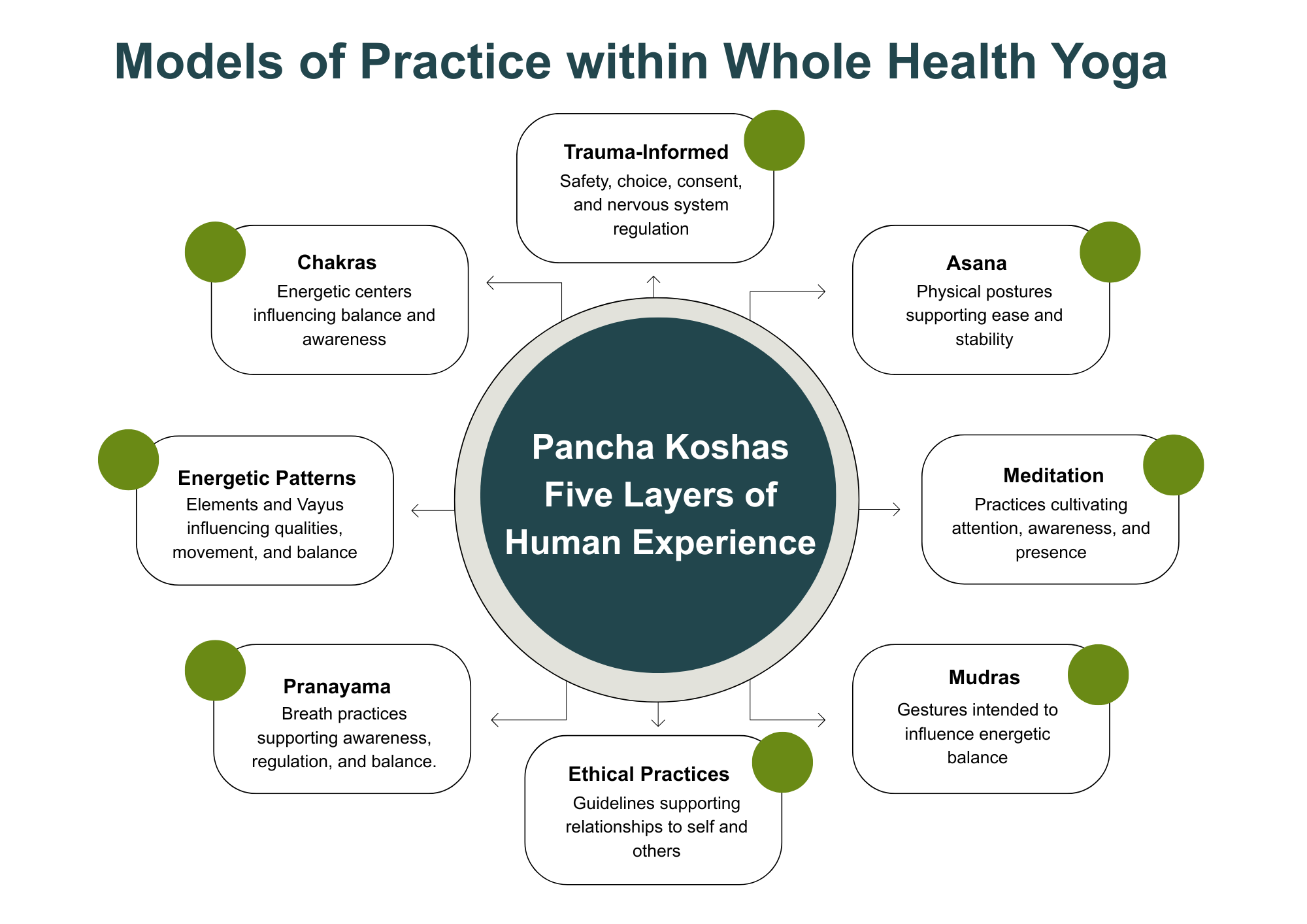
Trauma-Informed Yoga
Trauma-informed yoga is an approach to yoga that integrates the core principles of trauma awareness—such as safety, choice, consent, and nervous system awareness—into the way yoga is taught and experienced. Trauma-informed yoga seeks to create a safe and supportive environment that honors personal agency, respects individual boundaries, and encourages greater awareness of one’s internal experience across the physical, energetic, mental and emotional, and deeper layers of human experience described within the Pancha Koshas.
At this time, neither yoga teacher trainings accredited through Yoga Alliance (YA) nor yoga therapy trainings accredited through the International Association of Yoga Therapy (IAYT) universally require direct training in trauma-informed approaches as part of their standard curriculum requirements. However, many programs now choose to incorporate trauma-informed principles into their curriculum, and stand-alone trainings offer yoga professionals opportunities to further develop the knowledge and practical skills needed to apply these principles within their existing teaching and therapeutic work.
Although trauma-informed yoga is often associated with trauma recovery, many of its foundational principles—such as safety, choice, consent, communication, and nervous system awareness—may support greater self-awareness, autonomy, and overall well-being for individuals across many different life experiences. While trauma-informed approaches may vary across teachers, settings, and populations, these foundational principles continue to shape the way trauma-informed yoga is offered and experienced in both trauma-specific and general wellness environments.
The trauma-informed approach within Whole Health Yoga has been influenced by additional training, clinical collaboration, and ongoing professional learning within the fields of trauma-sensitive and embodied yoga practices. This includes foundational training in Trauma Sensitive Yoga with David Emerson and Jenn Turner, as well as continued engagement with the work of researchers and educators such as Catherine Cook-Cottone, whose writings, workbooks, and contributions to the field continue to support broader conversations surrounding embodiment, self-awareness, regulation, and whole-person well-being.
The development of this approach has also been deeply shaped through five years of teaching therapeutic yoga within behavioral health settings. My ongoing work with individuals experiencing stress, trauma, addiction recovery, mood disorders, and emotional dysregulation further deepened the understanding of trauma-informed and whole-person approaches to therapeutic yoga and care.
What Exactly Is Trauma?
A life experience may become traumatic when a person’s ability to cope, process, or maintain a sense of safety and stability becomes overwhelmed. Similar life experiences may overwhelm one person’s sense of safety and ability to cope, while another person may experience the same situation as stressful but manageable. In many cases, individuals are able to re-establish a greater sense of safety and stability over time as they develop supportive relationships, coping strategies, self-awareness, and additional resources that help them navigate future stress more effectively.
Within both modern neuroscience and yogic philosophy, the human system is understood to naturally seek greater balance and regulation following experiences of stress. However, there are times when the body and nervous system may struggle to fully return to that state of balance without additional support, awareness, or regulation practices.
Within the framework of the Pancha Koshas, unresolved experiences of stress or trauma may continue to influence not only the physical body and nervous system, but also the energetic, mental and emotional, and deeper layers of human experience until a greater sense of balance and regulation is restored.

Over time, through the guidance and collaborative support of a yoga therapist, this work may help individuals feel more grounded in their body, more connected to themselves and others, and more capable of moving through daily life with greater steadiness, awareness, and ease.
Safety, Choice, Consent, and Nervous System Regulation
Safety
Safety is experienced differently by each individual and may be influenced by past experiences, environment, relationships, identity, culture, and nervous system awareness. Within the framework of the Pancha Koshas, experiences of safety and regulation may influence not only the physical body, but also the energetic, mental and emotional, and deeper layers of human experience.
While a yoga therapist may thoughtfully prepare both the therapeutic relationship and practice environment to support a greater sense of safety, human experiences and nervous system responses can never be entirely predictable. Because of this, trauma-informed yoga emphasizes ongoing awareness, communication, choice, and adaptability throughout the therapeutic process. Through collaboration, the client and yoga therapist work together to support the safest and most supportive experience possible while also developing greater awareness of how to re-establish safety and regulation when needed. This may include adjusting the lighting in a room, changing the pace of a practice, pausing a breath exercise, or simply taking time to rest and reconnect with the present moment.
Choice
The power of choice is closely connected to an individual’s sense of autonomy, self-trust, and personal agency. Within trauma-informed yoga, choice is supported through education, communication, and consistent opportunities for the client to make informed decisions that help shape the foundation of their yoga plan and overall therapeutic experience. Within the framework of the Pancha Koshas, the experience of choice may influence not only the mental and emotional layers of human experience, but also the energetic, physical, and deeper layers connected to safety, awareness, and overall well-being.
For example, a client may be offered multiple movement or breath options and encouraged to choose the approach that feels most supportive in that moment.
Consent
Consent is closely connected to the principle of choice, yet the two are not identical. While choice emphasizes an individual’s ability to make informed decisions throughout the therapeutic process, consent refers more specifically to the ongoing permission and agreement given before and during a particular experience, interaction, or practice. Within trauma-informed yoga, consent may include verbal and nonverbal communication related to movement suggestions, breath practices, environmental adjustments, and the pacing of a session. Within the Whole Health Yoga approach, physical touch is used rarely and only after it has been clearly discussed and verbally agreed upon beforehand.
In practice, consent may involve ongoing check-ins throughout a session rather than assuming comfort or agreement based on an earlier conversation. Within the framework of the Pancha Koshas, experiences of consent and personal boundaries may influence not only the physical body, but also the energetic, mental and emotional, and deeper layers of human experience connected to safety, trust, self-awareness, and overall well-being.
Nervous System Regulation
Nervous system regulation refers to the body’s ongoing ability to respond, adapt, and return toward balance following experiences of stress, stimulation, or challenge. Within trauma-informed yoga, practices are often offered in ways that support greater awareness of internal experience through pacing, breath awareness, movement, environmental support, and opportunities for choice and rest.
This may include practices that encourage slower pacing, grounding, rest, breath awareness, or gentle movement intended to help the individual reconnect with a greater sense of steadiness and balance. Within the framework of the Pancha Koshas, experiences of regulation and dysregulation may influence not only the physical body and nervous system, but also the energetic, mental and emotional, and deeper layers of human experience connected to awareness, connection, and overall well-being.
Bringing the Models Together
Trauma-informed principles such as safety, choice, consent, and nervous system awareness help shape the way the other seven models are offered within the therapeutic relationship. The models explored throughout Whole Health Yoga are not intended to function as isolated techniques, but rather as interconnected approaches that support greater awareness, balance, and whole-person well-being across the many layers of human experience described within the Pancha Koshas.
Over time, through the guidance and collaborative support of a yoga therapist, this work may help individuals feel more grounded in their body, more connected to themselves and others, and more capable of moving through daily life with greater steadiness, awareness, and ease.
Future writings will continue to explore the remaining models of practice within Whole Health Yoga and the ways they may support overall well-being throughout daily life.
About the Author
Wendy Cook is the founder of Whole Health Yoga (WHY), a therapeutic yoga practice that blends the art and philosophy of yoga with evidence-informed approaches to whole-person well-being. With more than two decades of teaching experience, Wendy has worked in behavioral health settings, corporate environments, athletics, and individualized therapeutic care.
Since 2014, she has trained more than 300 yoga teachers through her Yoga Alliance–registered 200-hour teacher training programs. Her current hybrid training model combines virtual learning, individualized mentoring, and an in-person immersion experience in Guadarrama, Spain. Through this work, Wendy continues to cultivate a supportive teacher community grounded in ongoing education, mentorship, and meaningful connection.
Through Whole Health Yoga, Wendy offers 1:1 and small-group therapeutic yoga sessions designed to support individuals in cultivating greater balance, awareness, and overall well-being.
Ready to take your first step toward therapeutic yoga—or teaching?
Explore our 1:1 and small group therapeutic yoga offerings or join our next 200-hour YTT.